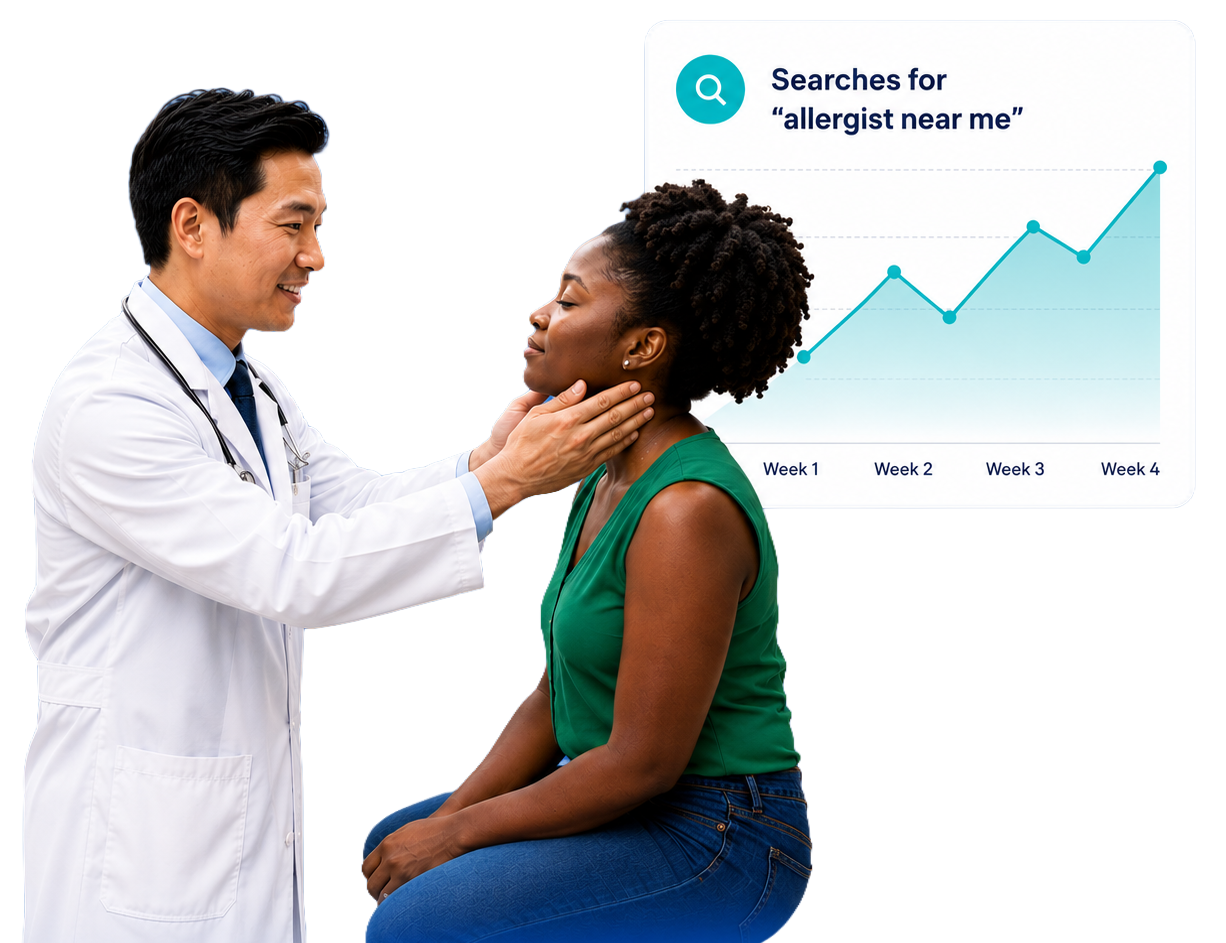
Local SEO for Allergists: Owning the Map for "Allergist Near Me"
When a patient searches for allergy care, the map pack decides who they call. A practical local SEO playbook built for allergy & immunology practices.
There is a moment, repeated thousands of times a week in your market, when someone types "allergist near me" and decides, in about eight seconds, who gets their first call. They are not reading your About page. They are looking at the three practices in the map pack: the names, the star ratings, the distance, the "open now." Local SEO is the discipline of making sure one of those three is you, and that you are the easy yes.
For allergy and immunology, this matters more than for most specialties. Allergy care is overwhelmingly local and recurring, testing, immunotherapy, follow-ups, a household that comes back for years. Winning the local search means winning a relationship, not a single visit. And unlike paid ads, the rankings you earn keep working after the campaign ends.
The map pack is the real homepage
Most patients never reach your website on that first search. They interact with your Google Business Profile, the listing that powers the map pack, and judge you entirely from it. Treat the profile as your most important page, because for new-patient search, it is.
Get the fundamentals exactly right and keep them that way:
- Primary category: Allergist. Add relevant secondary categories (Immunologist, Asthma clinic) but lead with the one patients search.
- Name, address, and phone that match your website and every directory, character for character. Inconsistency here quietly suppresses rankings.
- Real hours, including holiday hours. "Open now" is a ranking and a conversion factor.
- Photos that look like your actual practice, the waiting room, the team, the building from the street so patients recognize it. Skip the stock imagery; patients can tell, and so can Google.
- Services and conditions listed explicitly: environmental allergy testing, food allergy, allergen immunotherapy, asthma, eczema, chronic sinusitis, drug allergy. These terms are how patients describe their problem to a search bar.
Reviews are the ranking factor you can actually influence
In local search, review volume, recency, and rating do real ranking work, and they do even more conversion work. A practice with 180 reviews at 4.8 stars will out-book a practice with 12 reviews at 4.9, even from a worse map position, because the patient reads volume as trust.
The catch for allergy practices is HIPAA. You can ask for reviews; you cannot acknowledge that a specific reviewer is your patient, and you cannot respond with anything that confirms treatment. So build a compliant engine:
- Ask everyone, systematically. A post-visit text or email with a direct review link, sent to every patient, not just the ones who seemed thrilled.
- Make it one tap. Every extra step halves your response rate.
- Respond generically and warmly. "Thank you for the kind words. We appreciate you trusting our team." Never confirm the visit, the diagnosis, or the treatment. When a review is negative, respond with care and move the specifics to a phone call; never litigate details in public.
Train your front desk to make the ask part of checkout. Reviews are not luck; they are a process.
Build pages that answer real allergy questions
Your website still matters, both for the patients who do click through and for the organic rankings that feed the map. The winning structure is one strong page per condition and per location, not a single thin "services" page.
Create dedicated pages for the searches your patients actually run: allergy testing, food allergy testing for kids, allergy shots / immunotherapy, asthma treatment, chronic sinusitis, eczema. Each page should:
- Answer the patient's first questions plainly, what the visit involves, whether they need a referral, how long results take, what insurance you accept.
- Use the words patients use ("allergy shots") alongside the clinical terms ("subcutaneous immunotherapy").
- Offer exactly one clear next step: book, or call.
- Load fast on a phone. Most of this traffic is mobile, often searched mid-symptom.
If you operate multiple locations, give each its own page with its own embedded map, hours, and reviews. One generic page cannot rank for three towns.
Local proof signals: citations and links
Google corroborates your existence through citations, consistent listings in healthcare and local directories, and local links. Claim and align the obvious ones (Healthgrades, Vitals, Yelp, your hospital affiliation, your insurance directories) so your name, address, and phone match everywhere.
For links, think local and relevant rather than high-volume: the chamber of commerce, a sponsored youth sports team, a guest segment on a local morning show during pollen season, a school nurse resource page. A handful of genuine local links outperforms a pile of generic ones, and they reinforce the geographic relevance that local rankings reward.
Measure the right outcomes
Vanity rankings are a trap. Track the metrics tied to revenue:
- Calls and direction requests from your Business Profile (the profile reports these directly).
- Booked new patients attributed to organic and map traffic, via call tracking and form analytics.
- Review velocity, net new reviews per month, as your leading indicator of future ranking strength.
Local SEO compounds. A profile you optimize and a review engine you run today keep producing booked patients next pollen season and the one after, at a cost per acquisition that paid channels rarely match. The practices that own the map are not the biggest. They are the most consistent.
Want to know where you rank for "allergist near me" today, and what it would take to own the pack? Request a free local SEO audit.